

The ProgExpert blog
The ProgExpert Builder: custom software that evolves
Code generation, preserved development and AI agents: discover ProgExpert technology for building your software and accelerating its evolution.

Every development moves the next one forward. At ProgExpert, this idea takes a concrete form: our Builder. We have transformed our expertise into a development technology that brings together a code generation engine, reusable components and artificial intelligence agents able to collaborate within the project’s context.
We build software whose foundations can be regenerated and improved while preserving project-specific development in the designated extensions. A business rule, integration or workflow tailored to your team becomes an asset we continue to build on.
For your business, this means software designed for today’s operations, with a structure built to support tomorrow’s changes.
Choosing ProgExpert means choosing a team that develops your application while also advancing its own technology for building it. Here are the five strengths we bring to your project.
1. Generate what is shared. Develop what sets you apart.
Customers, files, bookings, service calls, documents: software rests on information and the connections that give it meaning. The Builder describes these elements in a structured model, with their fields, relationships and behaviours. This model drives code production.
It supports the generation of PHP models, data access, forms, lists and searches, among other things, according to the components selected for the project. Recurring mechanisms follow a shared structure. The team can focus more work on the decisions that make your software useful: your calculation method, approval steps, exceptions and user workflows.
A module then takes its place within a whole. A request received through a website can feed into a management file, then a customer portal and the tools used by the team. APIs and connectors link the necessary services according to the capabilities of the systems involved.
Your advantage: reusable development capabilities combined with the freedom to develop features specific to your business. The same principle supports an initial module and an application connecting several teams.
2. Preserve what you have built at every new stage
Software gains value as it incorporates your reality. It must be able to evolve while preserving that work. This is a central architectural decision in the Builder.
Generated parts have their own sources and rebuilding process. Project adaptations occupy extensions designed to be preserved. We can rebuild shared elements while retaining project-specific development placed in these extensions.
A new relationship between two files, an enhanced form or a shared improvement can thus fit into the application’s continuity. We examine the change’s effects and verify that specific rules work with the new version.
Your advantage: completed work remains a foundation for what comes next. You can consider adding a portal, process or integration with an architecture that anticipates this evolution.
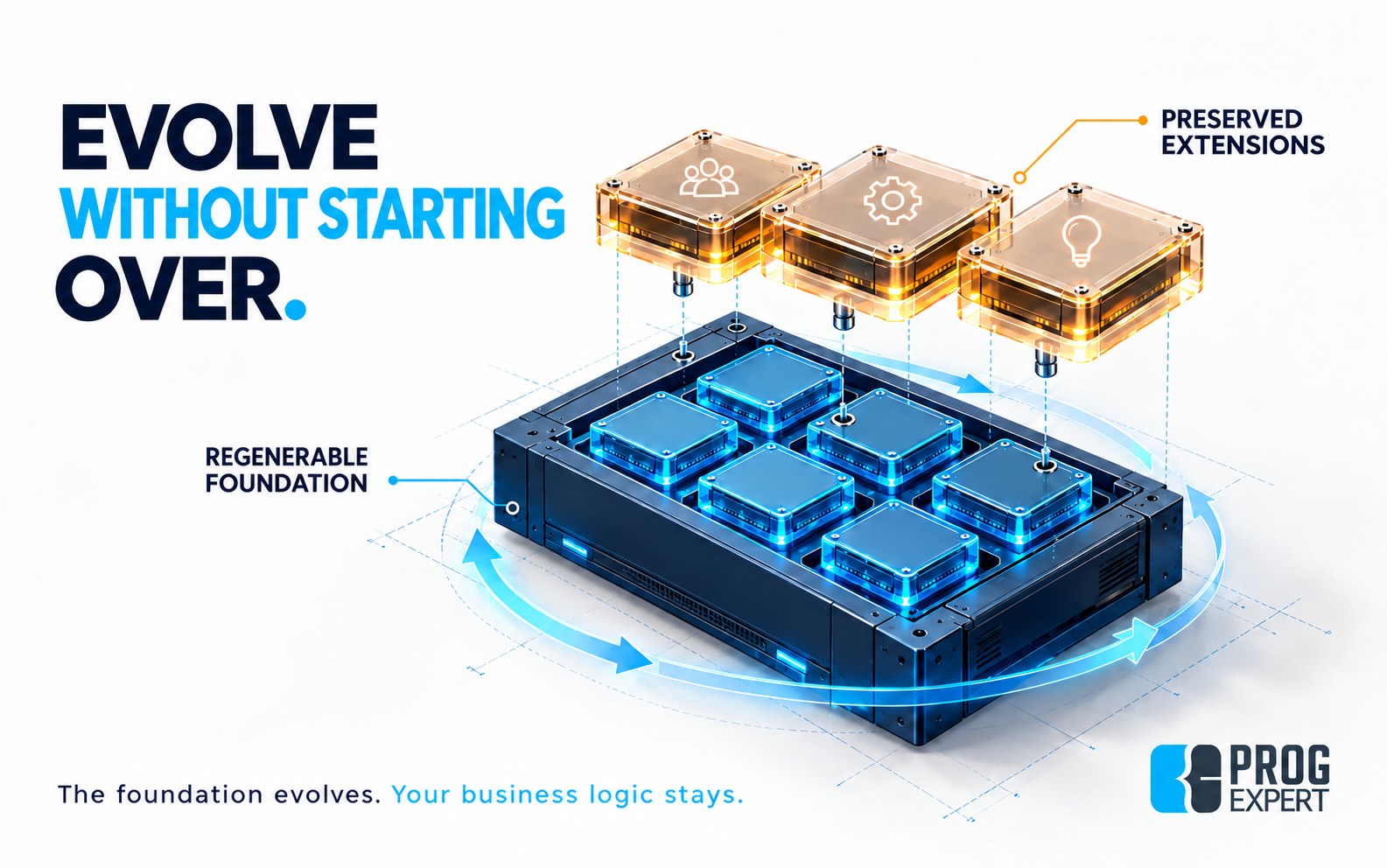
The foundation evolves. Your business retains its place. This illustration summarizes the separation between regenerable components and preserved project adaptations.
3. AI agents working together on your project
We connect AI to the Builder’s context and development tools. Agents work with the project’s structure, documentation and conventions. Depending on the assignment, they divide analysis, development and checks, then pass along what is needed to continue the work.
What they exchange is concrete: an analysis, project constraints, prepared changes and check results. A verification result can return to development to correct a rule or complete a workflow. Our team supervises choices and delivery.
Consider a request to illustrate this process: “Let our customers track their service calls.” Analysis identifies existing files, information to display and permissions to respect. Development receives this context to prepare adaptations. Verification then examines a file with no service calls, a missing date and access by another customer. Its findings inform adjustments.
Operations rely on the Builder’s authorized tools and their controls. The team confirms business rules, examines changes and validates the result with those involved. Exchanges between agents support this responsibility.
Your advantage: continuity between understanding the need, implementing it and providing evidence that it works. Context follows the assignment, and checks help improve the delivered work.
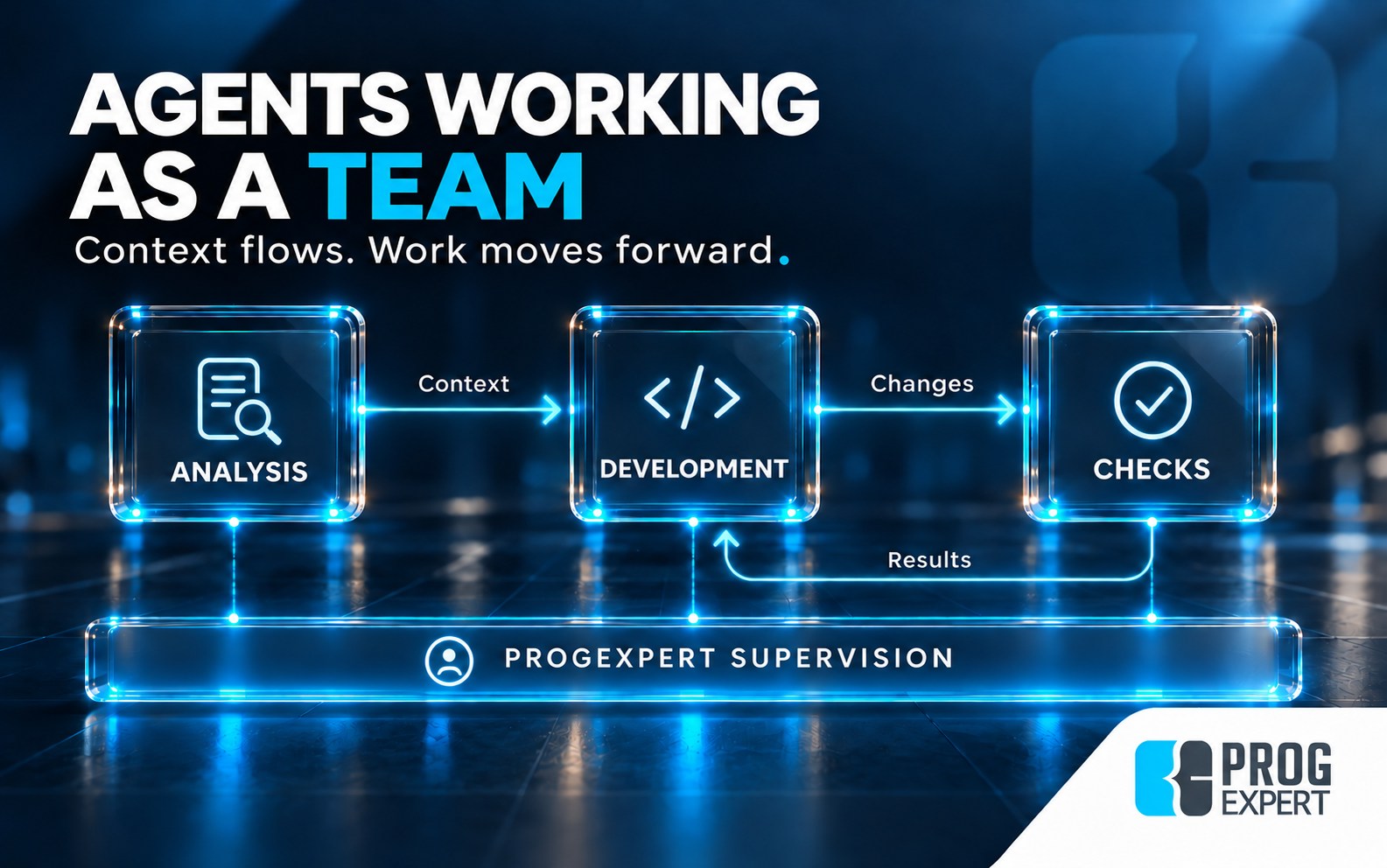
Context flows. Work moves forward. This diagram illustrates exchanges between roles; their distribution adapts to the assignment.
4. Understand the code to improve performance
Development speed and the speed of the delivered software are two subjects we address separately. Generation automates development mechanisms. Application performance is measured through its uses: opening a file, filtering a list, loading a screen or producing an export.
Our strength is the ability to work across the entire chain. MySQL organizes data, Propel connects it to business objects and PHP executes processing. Twig, JavaScript and Sass structure rendering, interactions and presentation. This organization provides precise places to understand a problem, maintain code and introduce an optimization.
If a screen becomes slow as records grow, we can examine queries, loaded information, processing and interface resources. A large export may require background processing with progress tracking. The response depends on what measurements reveal.
Your advantage: a team able to measure and improve the workflows that matter to your users. The Builder gives development structure; our understanding of the code lets us pursue gains where they are needed.
5. Advance the technology that builds your software
We also invest in the Builder’s shared components. An improvement to search, a form or interface behaviour enriches how we build. When relevant to an application, it can be adopted in the projects concerned after its effects have been validated.
Improvements to the foundation and development specific to your project thus each have their place. The software retains its personality while being able to benefit from advances in its development environment.
The build is part of this continuity. We generate the elements concerned, compare structures and prepare necessary migrations. Code, structure and data changes are distinguished to organize checks and the transition to launch. Testing and operational monitoring accompany delivery.
Your advantage: the ability to evolve, supported by technology we maintain and improve. The project can move forward in stages, with reusable assets and a framework for preparing what comes next.
Choosing custom software also means considering its ability to evolve
When choosing a partner, examine the proposed features and how they will be built. What portion of the work relies on reusable mechanisms? Where will your specific rules be preserved? How will a new version be checked? How do AI agents fit into the team’s work?
At ProgExpert, these questions come together in one answer: our expertise, our own development technology and AI integrated into how we work. We invest in all three to move your software forward with your business.
Do you have a process to simplify, tools to connect or an application ready for its next stage? Bring us your challenge. We will show you how to turn it into a concrete project, which features to build and how to prepare for their evolution.
Your next development can be the starting point for much more.

